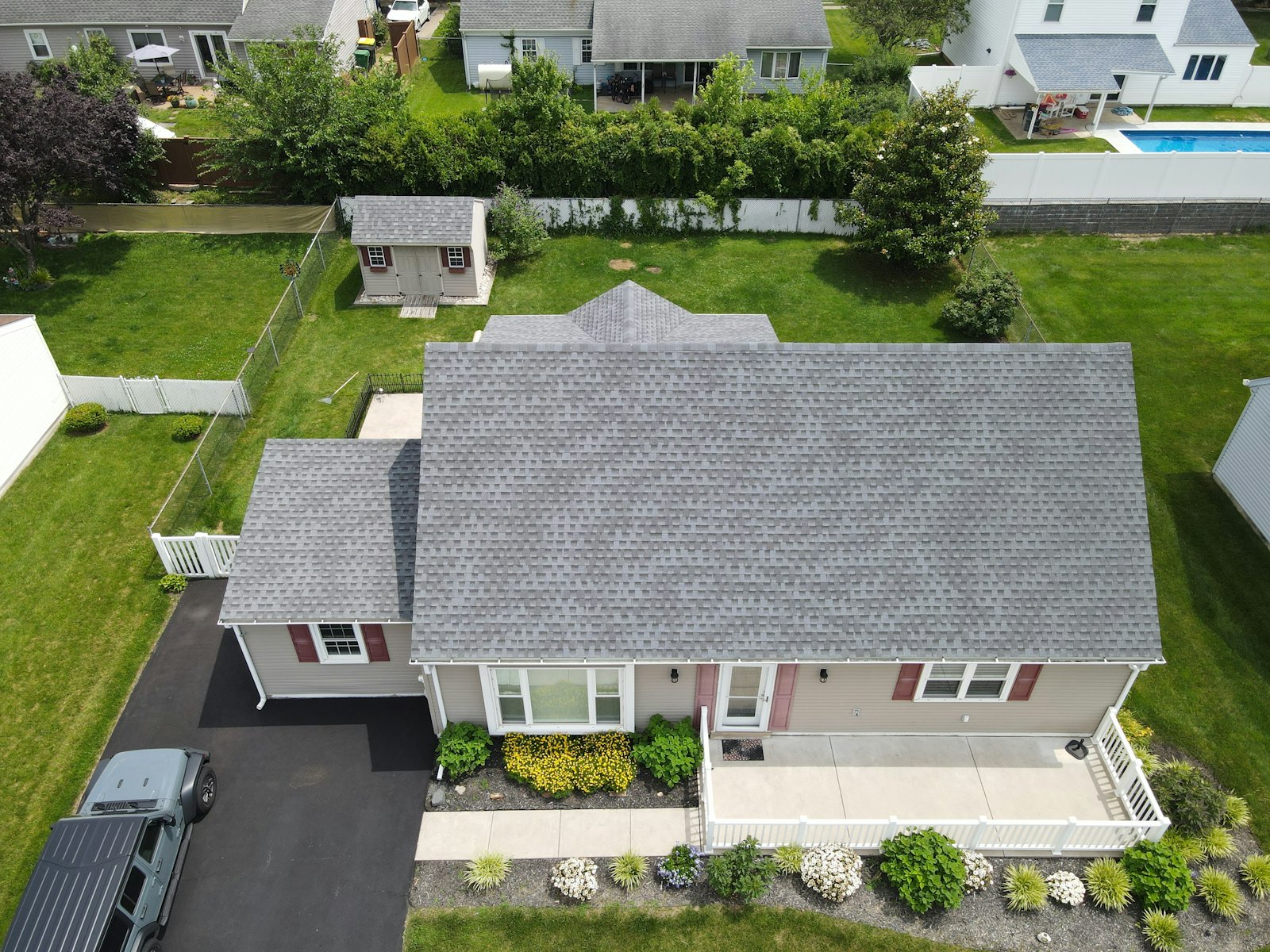
If you've searched "new roof cost" you know the routine: every result shows a $5,000–$30,000 range and calls it good. The range is technically accurate, the way "your house costs between $40,000 and $4 million" is technically accurate. Here's what's actually inside the number — and the four hidden line items that turn a "$10K roof" into a $14K roof on the day of the install.
The 2026 baseline numbers
For a single-family home with about 1,800 sq ft of roof area, mid-pitch (6/12 to 9/12), architectural asphalt shingles, with full tear-off:
- Material: $4,400–$5,800 (shingles, underlayment, drip edge, ridge cap, fasteners, ice-and-water shield in eaves and valleys)
- Labor: $4,200–$5,400 (4-person crew, 1.5 days, regional wage)
- Tear-off: $1,400–$1,900 (labor and dump fees for removing existing layer)
- Permit and inspection: $250–$450
- Contractor overhead and margin: $1,000–$1,400 (typically 9–13% of subtotal)
Total: $11,250–$14,950. The figure varies regionally — see the table below.
Material choice: the 7× spread
Roofing material choice swings the total cost by more than any other variable.
- 3-tab asphalt: $3.50–$5.00/sq ft installed. The cheapest option but largely phased out — manufacturers are pushing dimensional shingles for the same price range.
- Architectural / dimensional asphalt: $4.50–$7.00/sq ft installed. The 2026 default. Better wind ratings (110+ mph), better warranty (25–30 years), better appearance.
- Standing-seam metal: $11.00–$18.00/sq ft installed. 50+ year lifespan. Cool-roof rebates available in 28 states. The clear winner on a long ownership timeline.
- Concrete tile: $10.00–$17.00/sq ft installed. Heavy — requires structural verification. Common in the Southwest and Florida.
- Clay tile: $14.00–$24.00/sq ft installed. Beautiful and brittle.
- Natural slate: $20.00–$35.00/sq ft installed. 75–150 year lifespan. The roof outlasts the buyer, the seller, and probably their kids.
The four hidden costs nobody mentions until quote day
- Decking replacement. When the old shingles come off, soft spots get discovered. Most quotes include 50–150 sq ft of free plywood replacement; older homes routinely need 200–500 sq ft. Per-sheet upcharge: $4–$7/sq ft.
- Drip edge and flashing replacement. Code-required if existing pieces are corroded. Adds $1.50–$3/lf. On a typical home, that's another $300–$700.
- Pipe boot and vent replacement. Old neoprene pipe boots are the #1 source of post-replacement leaks. Worth replacing during the install — $35–$80 each. A typical home has 4–8.
- Ice-and-water shield extension. Code in cold climates requires it 24" past the warm wall. Older homes often have less than required, which becomes the contractor's problem (and your bill) at install time.
Labor: where the bill diverges from the marketing
Roofer wages from the BLS May 2024 OEWS show a national median of $25.80/hr for non-union and $34.10/hr for union. Loaded with insurance, fall protection, and overhead, contractors bill $55–$85/hr per crew member. A standard 4-person crew clears 1,500–2,000 sq ft of asphalt per day on a walkable pitch.
Pitch is the labor multiplier nobody clearly explains. Below 6/12: walkable, normal speed. 7/12 to 9/12: harness setup required, 15% slowdown. Above 9/12: scaffolding or roof jacks, 30%+ slowdown. A steep gable on the front of the house can add $1,000+ to the labor line over a flat-front home.
The 2026 trend context (without dating this article badly)
Asphalt prices saw double-digit jumps from 2023–2025 driven by raw material (oil derivatives) and tariffs on imported metal flashing. Most of that has plateaued in 2026. Labor wages caught up to broader construction inflation in 2024–2025 and are now growing at the wage-index rate (~3.5%/yr). The biggest live-pricing variable for the next 12 months is hurricane-driven material spikes in the Southeast.
Regional pricing (1,800 sq ft architectural asphalt, full tear-off)
| Metro | Multiplier | Typical total |
|---|---|---|
| New York, NY | 1.42× | $18,460 |
| San Francisco, CA | 1.45× | $18,850 |
| Boston, MA | 1.32× | $17,160 |
| Los Angeles, CA | 1.28× | $16,640 |
| Seattle, WA | 1.26× | $16,380 |
| Washington, DC | 1.24× | $16,120 |
| Chicago, IL | 1.10× | $14,300 |
| Denver, CO | 1.08× | $14,040 |
| Miami, FL | 1.06× | $13,780 |
| Austin, TX | 1.04× | $13,520 |
| Phoenix, AZ | 0.98× | $12,740 |
| Atlanta, GA | 0.96× | $12,480 |
When to DIY vs hire
Don't DIY a roof. The labor savings ($4K–$5K) don't offset the insurance, code, warranty, and fall-risk realities. Manufacturer warranties on shingles are void on owner-installed roofs. Most homeowner insurance won't pay for water damage from an unpermitted DIY roof. Real cost of a fall from a roof: hospital bill that exceeds the entire project.
Calculate your roof now
Use the roof replacement cost calculator to plug in your specific square footage, pitch, and material. It runs the same math we use for the figures above.
Frequently asked questions
What's the actual 2026 average for a new roof?
For a 1,800 sq ft single-family home with architectural asphalt shingles and standard tear-off: $11,200–$14,800 nationally. That figure includes materials (~38%), labor (~38%), tear-off and disposal (~12%), permit (~3%), and contractor margin (~9%).
Why did roofing prices jump 18% from 2023 to 2026?
Three factors: asphalt shingle raw material (oil derivatives) saw 22% price increases in 2024–2025, roofer labor wages caught up to broader construction inflation, and insurance liability premiums for roofing contractors rose dramatically after the 2024 hurricane season. Some of these are already moderating in 2026.
Is it cheaper to replace a roof in winter?
In northern climates, yes — 8–15% cheaper because demand drops and crews need work. The trade-off is that asphalt shingles can't self-seal in temperatures below ~40°F, which delays warranty start. Metal and tile installs are unaffected by cold.
Should I use insurance for a storm-damaged roof?
If the damage is documented and exceeds your deductible, yes. Insurance typically pays ACV (actual cash value, depreciated) up front, then RCV (replacement cost) after work is completed. Beware "free roof inspections" from non-local contractors after storms — these are often the start of insurance fraud schemes that leave you holding the bag.